Designing the driver experience for Proactive Dispatch, a launched program built on assigning drivers as packing began and linked to seven-figure annualized savings and 11% lower reliance on third-party couriers.
As a Senior Product Designer on GoPuff’s Delivery Apps team (2023–2024), I co-shaped the direction for Proactive Dispatch with senior product managers, then designed the driver experience from evaluating and accepting an offer through driving to the handoff site, waiting when needed, pickup, and scan verification.
I worked with stakeholders across engineering, product management, user research, customer support, and analytics within GoPuff’s broader Technology, Product, and Design organization. I partnered closely with engineers through delivery, including contributing production code during review and testing.
The central challenge was to start assignment as soon as packing began so drivers could accept and travel during preparation, bringing arrival and readiness into closer alignment while safely handling the cases where a driver arrived first.
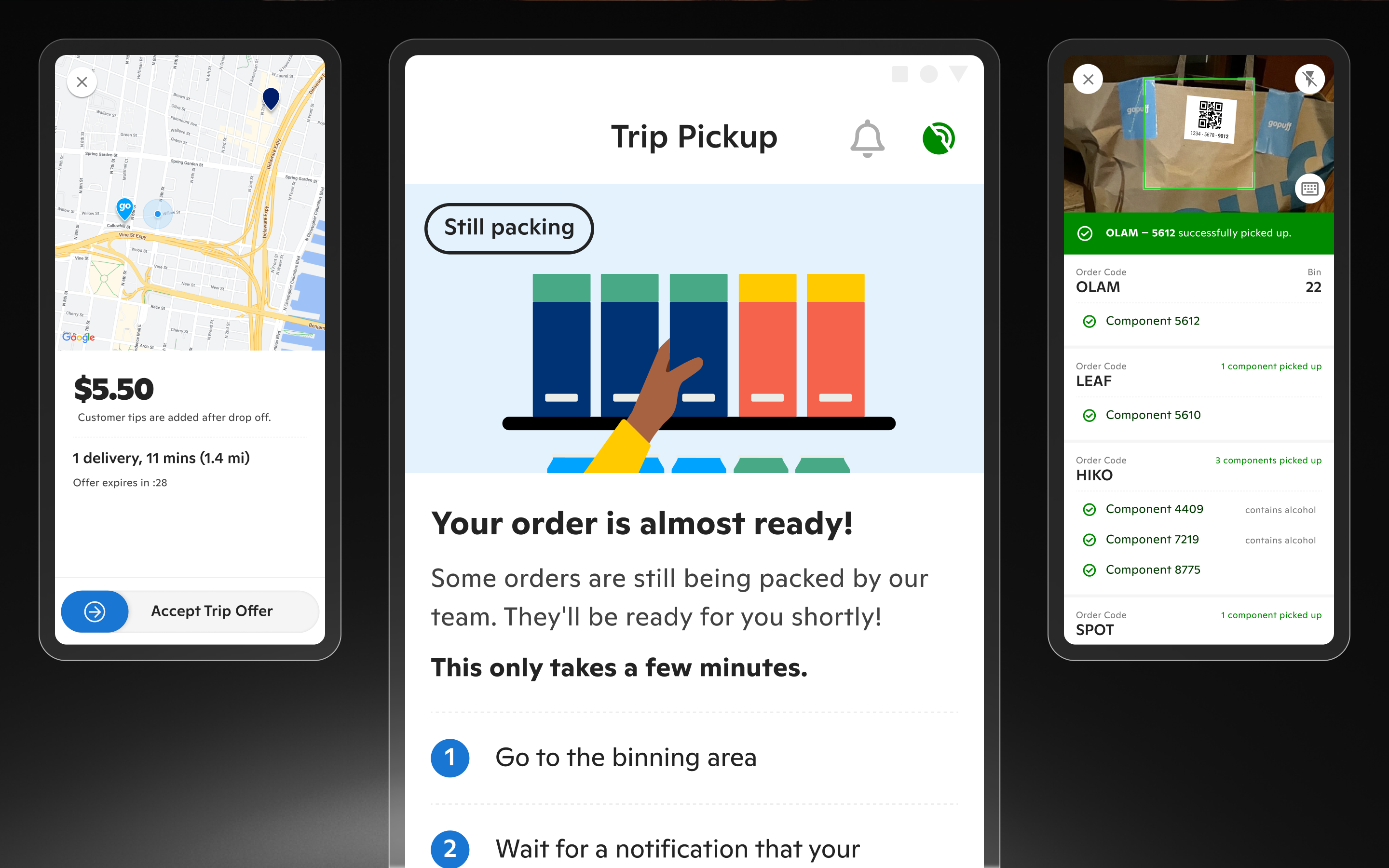
What I led
- Co-shaped the Proactive Dispatch strategy and the decision to assign drivers as soon as packing began.
- Designed the driver journey across offer acceptance, travel to the handoff site, waiting when needed, pickup, and scan verification.
- Delivered the experience with the cross-functional Delivery Apps team, contributing production code during review and testing.
“Caleb demonstrated amazing ownership and put together a thoughtful approach that included design elements that set the stage for improvements beyond the specific workstream in progress.”
*Jessi Zachman, Senior Product Manager, in a company-wide employee recognition post*
Impact
Approved leadership attestation linked the launched program to:
- Seven-figure annualized savings and 11% lower third-party-courier reliance.
- A 33% reduction in pickup traffic and delayed drop-offs across the 300 highest-volume sites.
- 5.8% lower mean bin time.
- Batches of four or more orders, with mid-six-figure annualized savings associated with fewer driver-canceled product orders.
- Delivery time improved by 1.1 minutes at p90 and 2.8 minutes at p97.
Why timing mattered
GoPuff fulfills orders through hundreds of micro-fulfillment centers. Each delivery moves from picking and packing, to driver pickup, to customer handoff.
When drivers were assigned only after packing finished, packing and travel happened sequentially. Starting assignment with packing allowed those activities to overlap, but introduced a different risk: a driver could reach the site before the order was ready.
BEFORE: SERIAL

[PACKING STARTS] -> [PACK] -> [READY] -> [ASSIGNMENT] -> [ACCEPT] -> [DRIVE TO SITE] -> [PICKUP]

AFTER: OVERLAPPED

[PACKING STARTS]
       +-> WAREHOUSE: [PACKING] ==================> [READY]
       +-> DRIVER:    [ASSIGNMENT] -> [ACCEPT] -> [DRIVE TO SITE] -> [ARRIVE]

TARGET:      [ORDER READY] + [DRIVER ARRIVES] -> [VERIFY] -> [PICKUP]
CONTINGENCY: [DRIVER ARRIVES FIRST] -> [WAIT AS DIRECTED] -> [HANDOFF]
Product strategy
We designed the flow around four connected moments: assignment as soon as packing started, acceptance and travel during preparation, clear instructions if the driver arrived first, and an unambiguous handoff before departure.
This made Proactive Dispatch more than a backend assignment change. In other words, it became a driver-facing operating model.
1.Assign drivers as packing begins
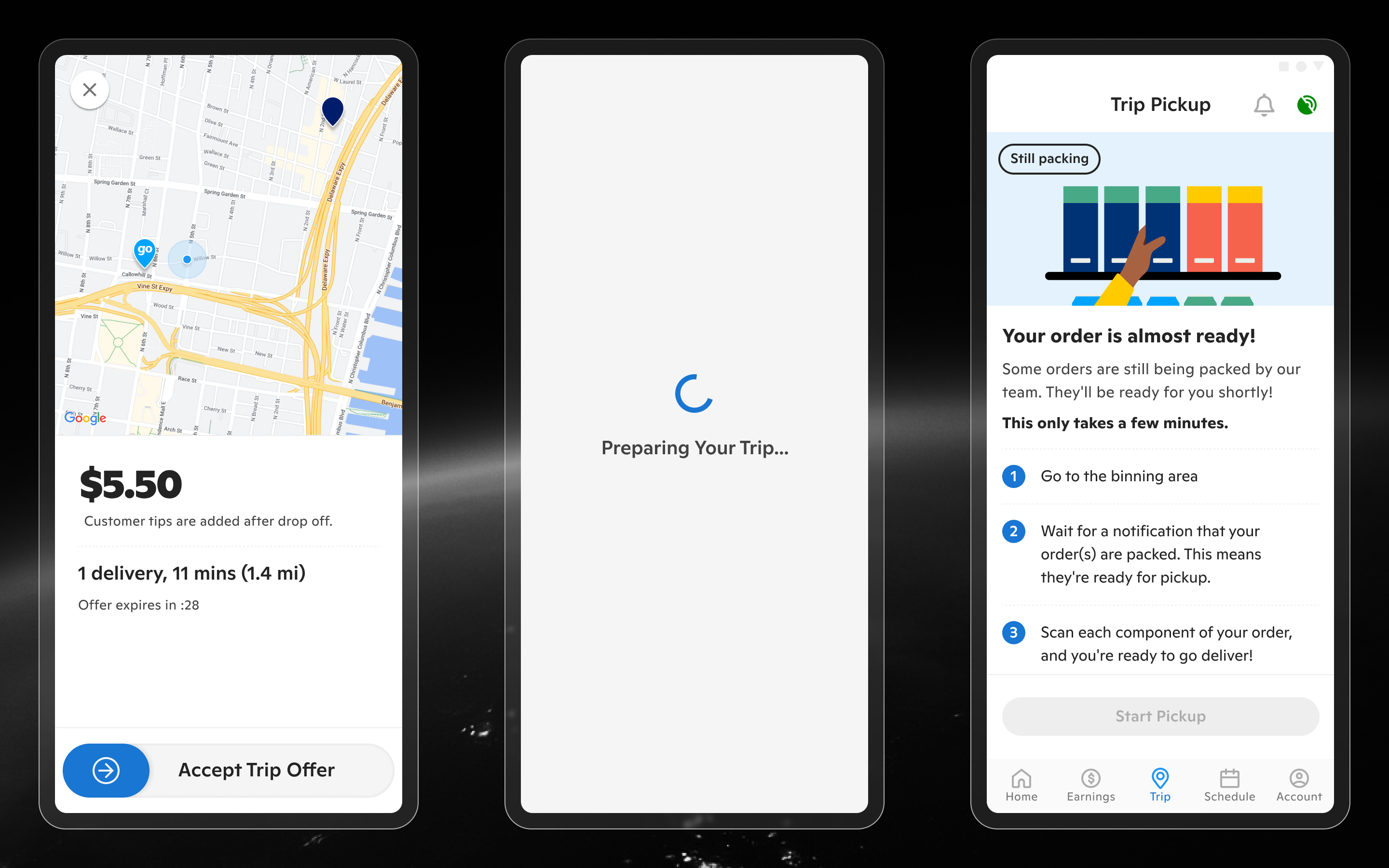
With senior product managers, I evaluated the operational tradeoff and co-shaped the decision to trigger driver assignment as soon as packing started. I then designed around the consequences of drivers accepting offers before orders were ready.
I designed the full-screen offer around the information drivers needed to evaluate a trip quickly: payout, estimated distance and time, route context, and expiry. After acceptance, the preparing state kept the trip visible as the driver traveled to the handoff site, without implying the order was ready for collection.
I designed around the hypothesis that triggering assignment at packing start would let acceptance and travel absorb most of the packing window, bringing driver arrival and order readiness into closer alignment.
2.Get drivers to pickup at the right time
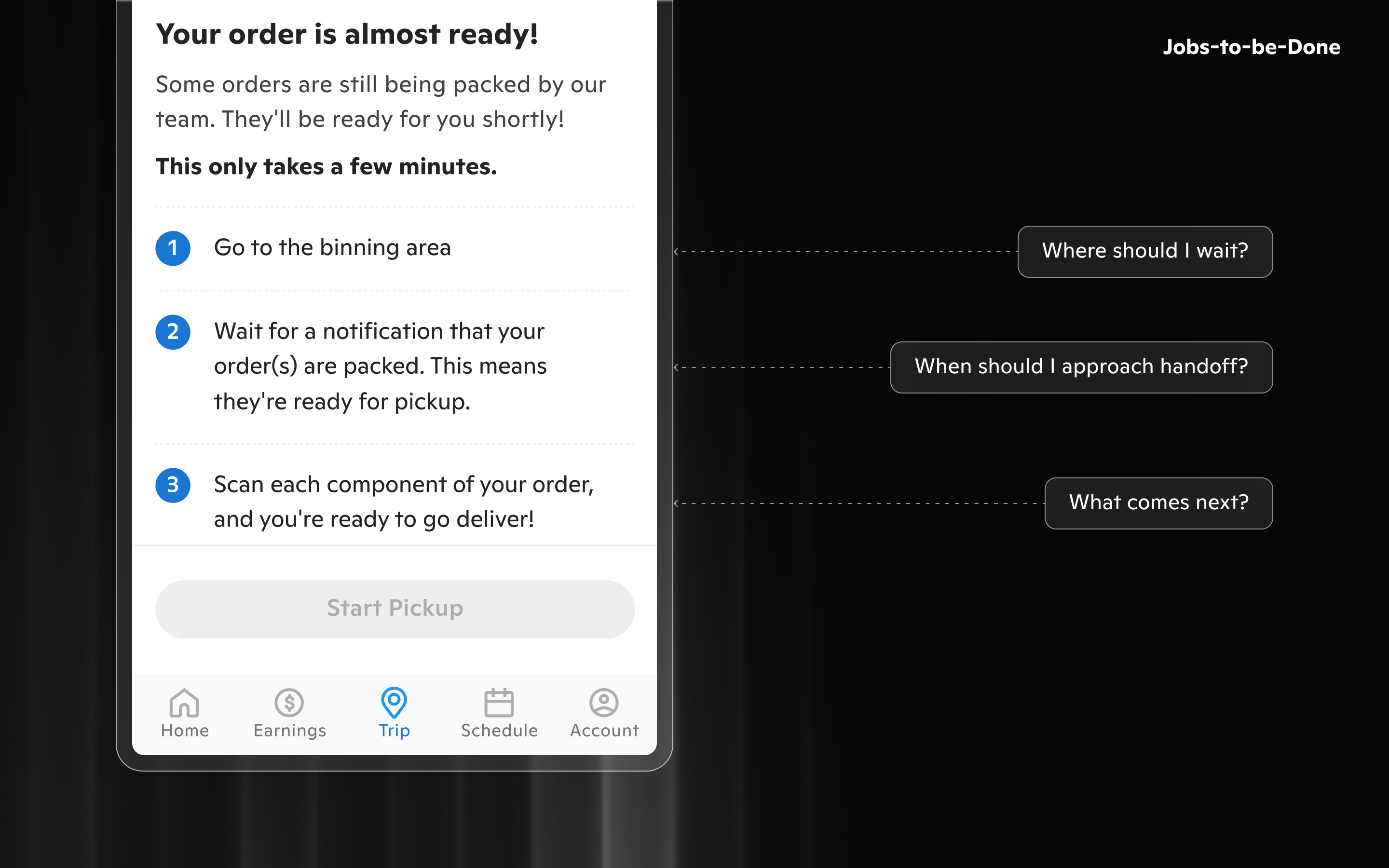
The timing bet would not align perfectly on every trip. When a driver reached the warehouse before the order was ready, the experience needed to bridge the remaining gap without creating confusion or congestion.
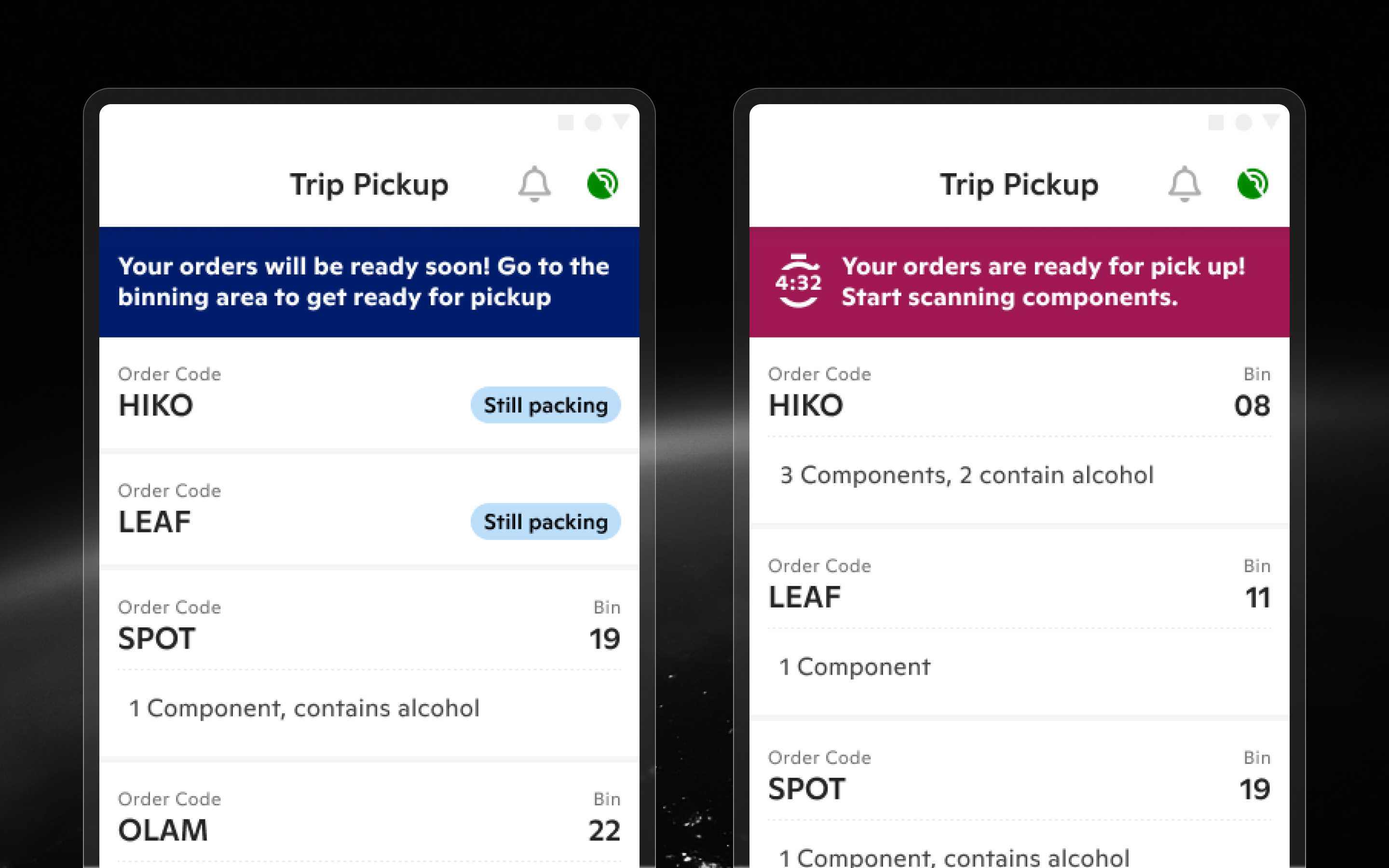
I designed the wait-for-packing interstitial for the cases where the driver arrived first. It told drivers where to wait and signaled when they should approach the handoff area, turning the remaining preparation time into a clear next step.
The wording carried its own risk. If “almost ready” appeared too early or too often, the product would erode the trust that Proactive Dispatch depended on.
3.Verify pickup before departure
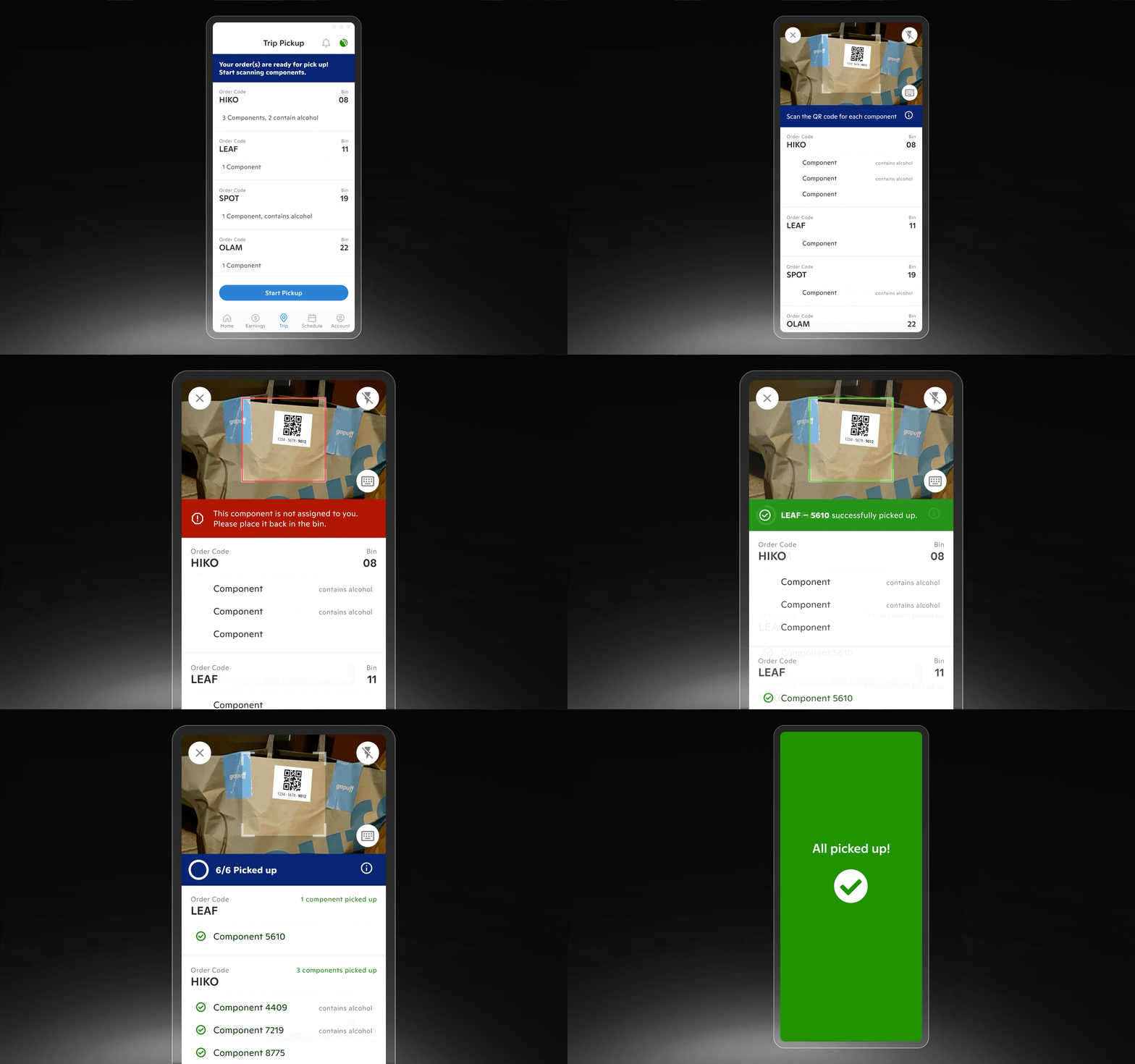
Beginning assignment with packing also increased the importance of a reliable handoff. A driver could be collecting multiple orders in a busy environment, with each pickup carrying order codes, bin locations, component counts, and, in some cases, age-restricted items.
I designed the pickup surface around those identifiers and made scan feedback explicit, including duplicate-scan states. This moved error detection to the facility, before an incorrect or repeated pickup became a failed delivery.
I kept verification lightweight, preventing pickup errors while preserving the time gained upstream.
Planned Follow-ups
The shipped experience distinguished between orders still being prepared and those ready for collection. I designed two extensions to make that state model more operationally precise on both sides of readiness.
Before readiness, component-level progress would show drivers what had been packed and what remained in preparation. After readiness, a visible pickup window would make continued assignment conditional on action; if collection did not begin within the allotted time, the system could assign the order to a different driver.
Together, the concepts extended the principle behind the launched flow: make operational state visible, then give drivers a clear action for each stage. My team decided to plan both as follow-up work for a future sprint.
Outcome
Starting assignment with packing, alongside larger batches, improved both delivery performance and program economics. Leadership linked the launched work to seven-figure annualized savings, lower third-party-courier reliance, improved site and bin-time measures, and mid-six-figure savings from fewer driver-canceled product orders.
The same operating model reduced delivery time by 1.1 minutes at p90 and 2.8 minutes at p97. Together, the results show how changing assignment timing improved the system while the waiting and verification experiences managed the operational risk created at handoff.
Reflection
What stayed with me was how much of the driver experience was shaped before a driver ever touched the interface.
Timing changes create new interfaces. Here, starting assignment with packing improved delivery performance and economics because the experience guided drivers to the handoff site as the warehouse prepared the order, handled the cases where they arrived first, and helped them verify the right goods before leaving. The value came from pairing Proactive Dispatch with the safeguards people needed to act on it.